

Thursday, June 13, 2013
Launch 1!
So i need to make dinner and have some semblance of a life, but we launched the Powell oats with the tide this evening! Here is a teaser pic for you all.


Saturday, June 8, 2013
What up in the Pac Nor West?
The Powell boat project this past week became an exercise in watching paint dry. So after cleaning the shop re-applying paint and cleaning some more we decided to hell with it lets go sailing.


All fun aside this boat was built in 1982 by the school. Now it is owned by two of the instructors, one of them being Ben, score!

Look closer at the above photo you can see Mount Rainier right behind the bridge.

Don't let the grin fool you gaff rigged boats are fairly slow compared to modern rigs. The gaff does make it look amazing though.


With all the fun i'm also getting ready to move, packing up the office and feeling fairly grumpy about it. Well it has to be done.

Meanwhile in the garage the IRH was hard at work getting a seat installed.


The seat is tilted forward so water will run into the cockpit. There are also drain holes in the corners aft. All this drainage will help the builge pump installed underneath get the water out of the cockpit.
Finally the Powell boats are looking Sweet! We will be launching them at 6pm this Thursday the 13th at the Boat School. If your lucky enough to be around Lees Ferry (Grand Canyon put in) on August 1st you should be able to get a look as they slip under the bridge and into the canyon.

I'll keep you all posted as these things develop.
Wednesday, June 5, 2013
Oar Wrap Revisit.
With all this oar making i have really had oars on the brain.Were getting down to the business of leathering the oars. It got me thinking about modern oar wrapping. For anyone who has had to wrap oars without the help of a machine you know what a pain in the ass it is.


Anyway i was up last night thinking about how i was going to make the job of wrapping oars easier on me, after all there must be a better way to do this. Last night while reading i think i found the answer, a Serving Mallet.

This tool was originally made to make lines on tall ships fatter so they wouldn't hurt sailors feet. I instantly thought about making a big one for wrapping oars. Today i did.


I thought i would never say this... "I cant wait to wrap my next oar.
On the Powell front, Paint!


Sunday, June 2, 2013
Two projects one post.
The Powell boats have really hit their stride as the oar factory continues. At last count all the oars were either finished or on the bench being built. Meanwhile team sand and paint were getting their ducks in a row. Say good bye to the oaken exterior of the hulls, its primer time.


Meanwhile in the garage the IRH is getting her for and aft decks on. So just a brief explanation of how its done. Strips of red cedar are first coated on three sides with un-thickened epoxy.

Next, using a syringe run a bead of thickened epoxy down the side of the strip that will but up against the adjacent one. Then the strips are stapled down. Once the strip is down scrape off the squeeze out. After its all done using a 1/8" foam roller roll un-thickened epoxy over the whole thing.


After the whole mess has cured cut the excess deck off using a hand saw (not a flush cut router, unless you want to ruin the deck angle) and fair it down using a hand plane.

I rough sanded the decks to semi fair them. If i decided to take them to completely fair i would need to add a layer of cloth to the assembly and i don't want to add the weight. So here it is, lookin' sweet.

All I've got to do now in build the seat assembly, install the bilge pump system, install the hatches, paint the interior, flip and do all the glass work on the hull, install the gunwhale and oar locks then paint the bugger. Seams like a lot but over all real progress has happened over the last two weekends.
Thursday, May 30, 2013
The oar factory goes on...
As i have said before its all about layout. If you don't do it the end product will reflect that.
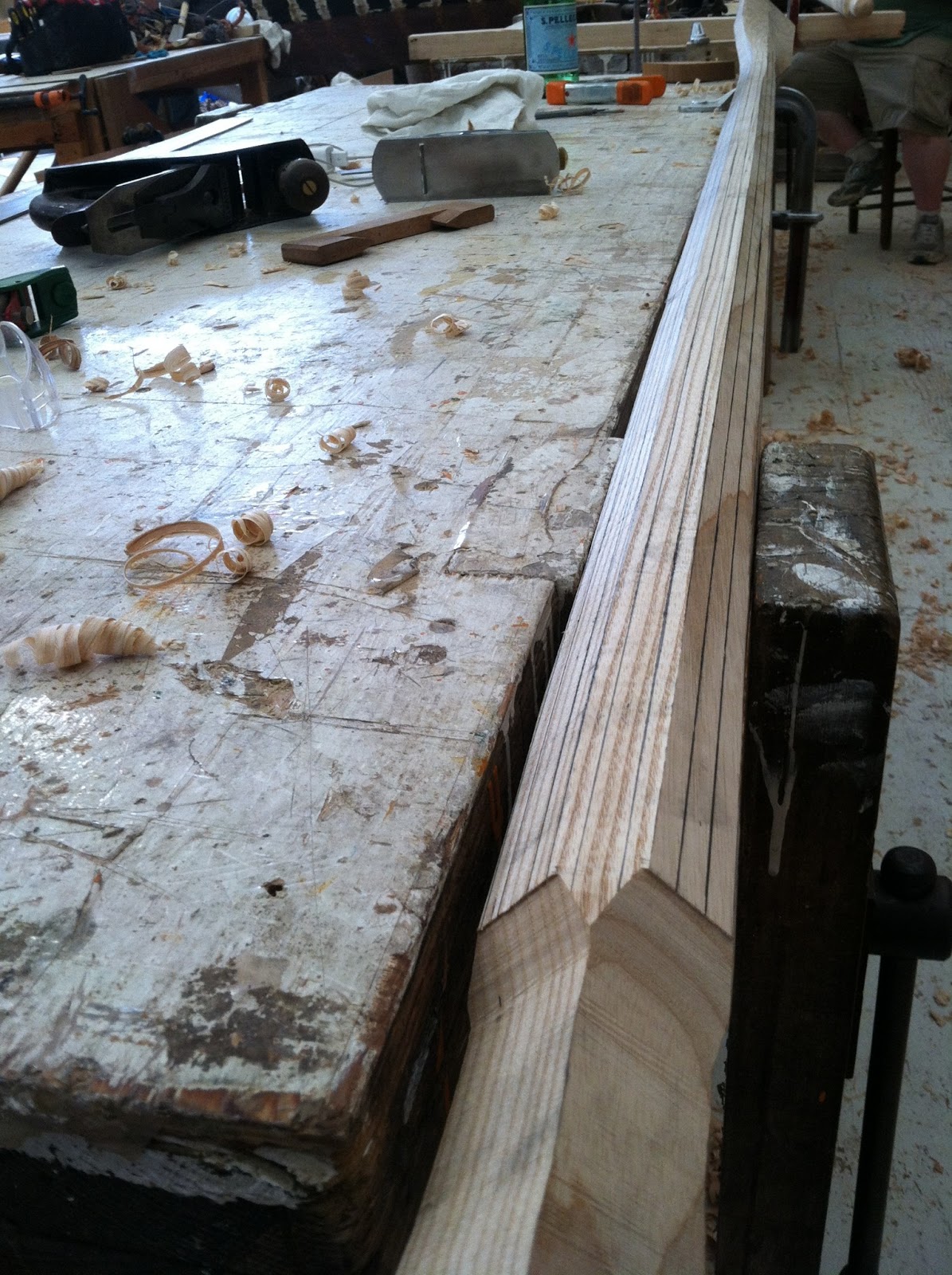
If you tiptoe around and lines you will never get anything done. A draw knife will hog off material fast. Be careful though you could potentially pull off way to much wood.


Monday, May 27, 2013
The other boat, IRH.
For followers of this blog it may be easy to forget that i don't just work on the Powell boats. In fact they were just a happy accident. I have lately been developing a very small drift boat design called the IRH.
The Weekend out here dawned very wet. Its not really a surprise giving the geographic location of Port Townsend Washington. Look at the photo below 5:30pm on a holiday weekend. No parking spots on main street, outside only quickly walking people heads bent to the wind.

This amazing weather really gave me the excuse to knuckle down and get some work done on the IRH. I haven't really had the energy to get any work done on her since the McKenzie River trip. I don't have any good reason, lazy?
No matter the game is back on. The first order of the weekend was to fabricate side boards. The way the coaming the side boards rest on allows the panels to lay flat. That made it really easy to fabricate them, i wish the for and aft deck would be that easy.


After the side boards were fitted i needed to build the forward and aft deck supports. The decks are compound curves which means that they are concave athwart-ships and convex for and aft. This gives the finished boat a very complex beautiful look but is a real pain in the ass to produce.

You can see both of them in the above photo. The construction of these supports was a little complex using the deck camber guide i built months ago. Then they were fastened to the boat just like everything else on the build, fillets of thickened epoxy. I really want to avoid mechanical fasteners.


She really is starting to look good. I haven't decided if i am going to finish the interior and then flip and finish the hull. Or i could flip, finish the outside and return to the interior at a later date. I cant do any more today so i think i'll have a beer and not worry about it.
Cheers!
Friday, May 24, 2013
Corkin' and the oar factory.
The team has split into two groups the first is corking the seams on the boats and the second is turning out oars.
I'll start with the corkers. Corking, corkin', or caulking is a method of sealing plank seams where cotton or oakum is driven into the seam in order to make it water tight. First the seam is cleaned, then raw linseed oil is painted into the seam. Next the cotton or oakum is pounded in and painted. Finally the seam is covered in seam compound.


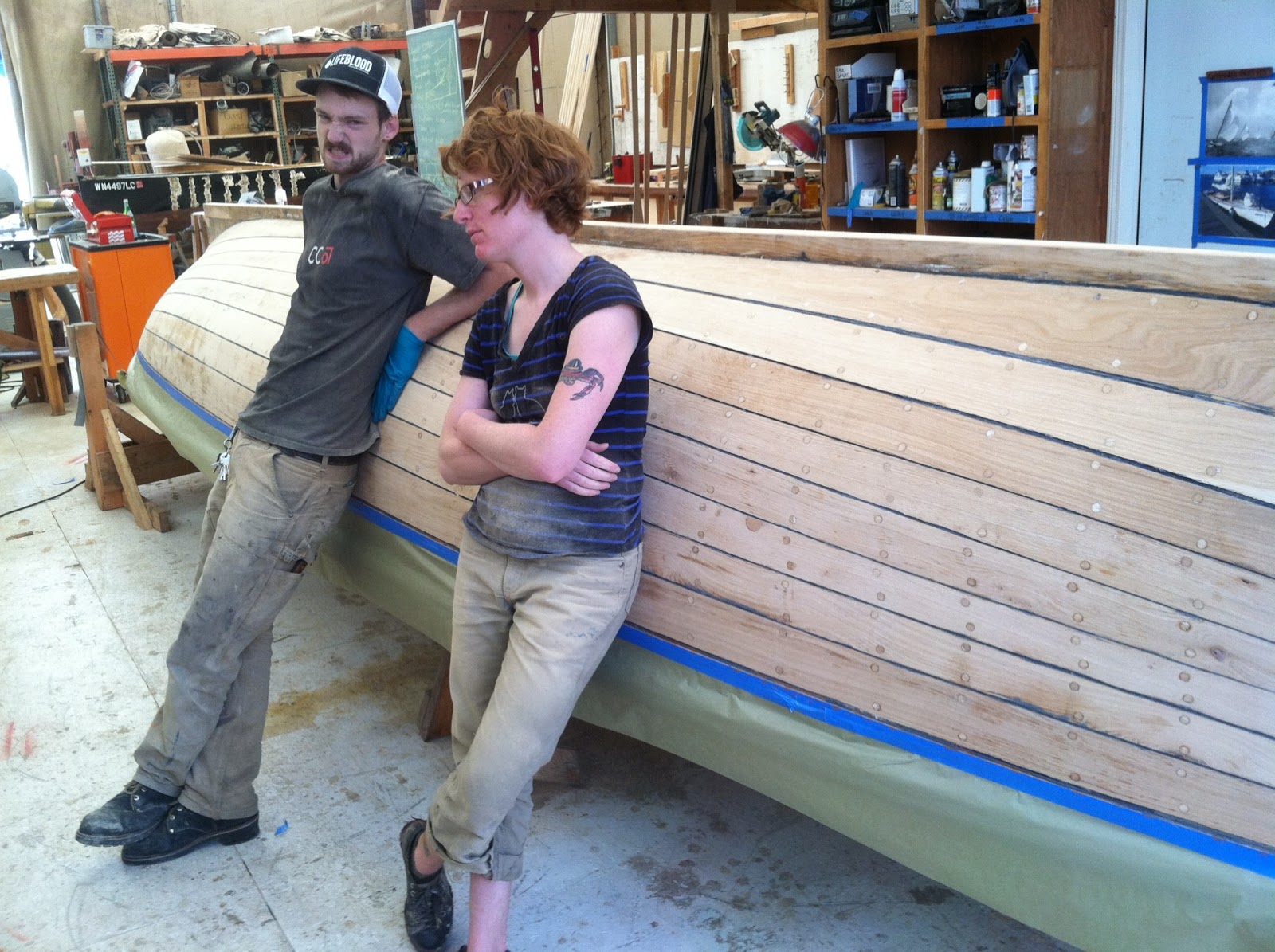
The above description is for boats whose seams are tight enough to take the corking. The problem with the Powell boats is although they were planked extremely tight the planks have shrunken grossly due to the use of very green oak. (the selection of this wood was a huge amateur mistake, none of the instructors at the school thought it would be a good idea.) With the shrinkage a solution had to be decided upon.

The above photo shows the solution. As you can see there is a cedar spline in the seam with the cotton or oakum. The cedar is quite soft compared to the oak so when the planks begin to swell the cedar, cotton/oakum mix will simply crush together sealing the plank seam.
Were not reinventing the well here. Some older boats who have had damaged plank seams and were unable to spend the money to replace every other plank have been corked up this way with success.


In the back corner of the shop team oar (which i am a part) is hard at work carving the crap-load of ash oars that will accompany these boats down the Grand Canyon.

Its really fun work, lots of layout and hand tool work. Ash is a little stiff to work so the key is razor sharp blades in all the tools. With that the strips of wood just peal right off.


By the end of the day today one boat was corked up except for the garboard seams, the other was close behind and there were six finished oars stacked in the corner of the shop.
Subscribe to:
Posts (Atom)